
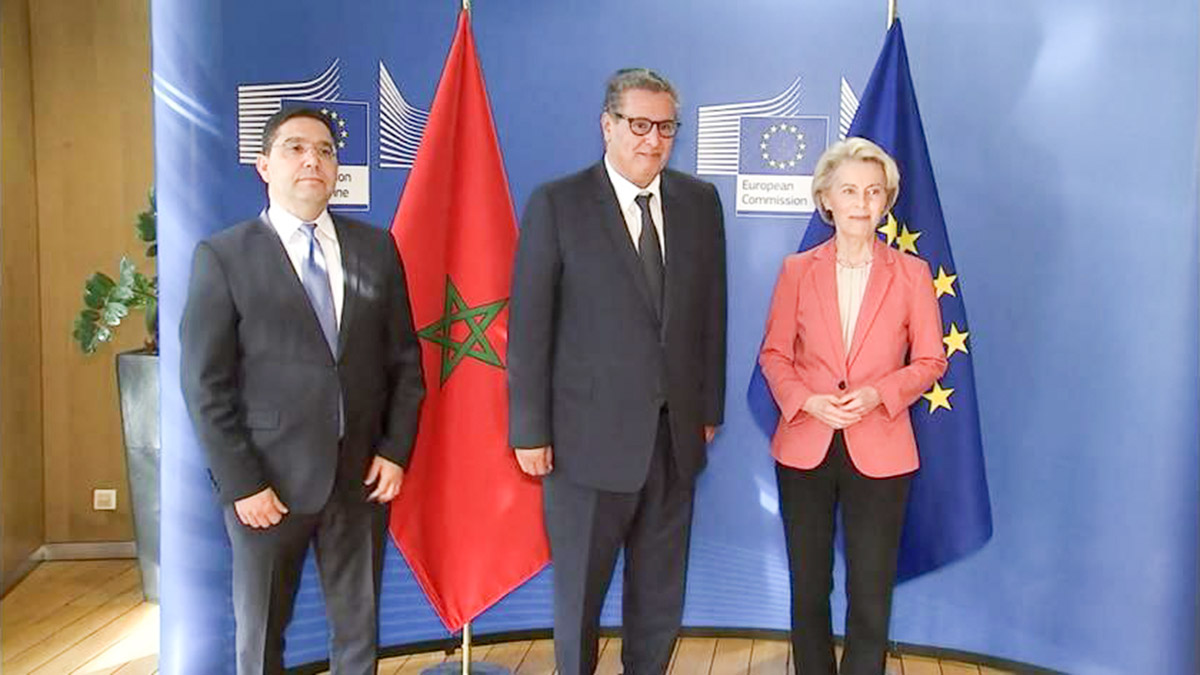
Morocco’s Minister of Foreign Affairs, Nasser Bourita, on Thursday expressed strong optimism about the future of Morocco–European Union relations during the 15th Association Council meeting in Brussels. Speaking ahead of the session, Bourita said he was confident the discussions would yield positive outcomes and open new perspectives beneficial to both sides. The meeting was co-chaired by Bourita and EU High Representative Kaja Kallas, with European Commissioner for the Mediterranean Dubravka Šuica representing the European Commission.
The council meeting holds major symbolic and strategic significance as it coincides with the approach of the 30th anniversary of the Morocco–EU Association Agreement. Bourita highlighted that three decades of cooperation have resulted in a strong, diversified institutional partnership, placing Morocco among the EU’s most important partners in the Mediterranean region.
Emphasizing Morocco’s stability in an increasingly uncertain global environment, Bourita noted that under the leadership of King Mohammed VI, the kingdom has positioned itself as a reliable and forward-looking partner. He stressed that Morocco remains clear in expressing expectations while consistently honoring its commitments, a principle that continues to guide its engagement with the EU.
Bourita also reaffirmed Morocco’s role as the European Union’s leading trade partner south of the Mediterranean and in Africa, suggesting that this model of cooperation could inspire future EU engagement with its southern neighbors. He added that the broad participation of EU member states at ministerial level reflects Morocco’s central role in addressing regional and global challenges.
Spanish Foreign Minister José Manuel Albares welcomed the meeting, describing Morocco as a key partner for both the EU and Spain. He highlighted strong commercial ties and praised cooperation on migration, noting record-low levels of irregular migration along EU routes. Albares reiterated Spain’s commitment to maintaining EU–Morocco relations at the highest level.
Discussions during the council covered political, economic, and trade cooperation, democracy and human rights, migration, green transition, innovation, security, and sustainable development. Both sides reviewed progress under the 1996 Association Agreement and reaffirmed their shared determination to deepen and renew the partnership amid evolving regional and international dynamics.